ScholEr is a community of learning & intellectual engagement. It is for the exchange of views, knowledge and experience for the greater good. Our aim is to enrich open(ing) minds and empower the growth mindset, rather than one of victimization & blame. If you identify with the former, please join us for respectful intellectual debate grounded in canonical fact, shared enthusiasm for science, and deep thoughtful conversations.
23 Ways You’re Already Living in the Chinese Century
The robotics explosion. The energy revolution. The cultural takeover. It’s everything you wanted for the United States—but done better in China.
Cy
Cyrilcommented · 2 weeks ago
New data from energy think tank Ember shows that solar supplied 12.8% of US energy generation in May — marking not only the highest share ever recorded for the clean energy source, but also the first time it’s surpassed coal. #ScholER #Data is beautiful https://sherwood.news/world/solar-generated-more-power-than-coal-in-the-us-for-the-first-time-ever/?utm_source=snacks&utm_medium=email&utm_campaign=snacks_20260615&utm_content=f56f3bdef8972461ef7ae51424d69b7b
High temps = high costs… Over the past decade, heat waves have cost California alone nearly $8B. Studies have shown that ~3B US labor hours were lost in industries like agriculture, construction, and ...
sherwood.news
The US’s first major heat-safety rules could protect 36M workers as temps spike nationwide
The dog days of summer… could get their first US leash. Fourth of July sweat stains are no joke: 75M Americans were under heat alerts to start...
TS
Todd Smithcommented · last month
Europe has already shattered meteorological records this summer, and things are likely to get worse https://www.nytimes.com/2026/07/29/world/europe/summer-heat-wave-fires-climate-change.html?unlocked_article_code=1.1VA.awhz.XBvirZKfGWbn&smid=url-share&utm_source=snacks&utm_medium=email&utm_campaign=snacks_20260730&utm_content=20964af6990a9ea2bb51dc7b9d41dd79
Has the #Artificial Intelligence industry officially shifted from a commercial, democratic ecosystem into a tightly controlled, national security apparatus reminiscent of the Manhattan Project? #Scho...
albertoromgar.medium.com
The AI Industry as You Know It Died Today
OpenAI announced GPT-5.6, but a terrible thing has happened
Ta
Tasiacommented · last week
The Trump administration is weighing sweeping semiconductor tariffs that could extend to data-center servers and other chip-powered goods, alarming tech companies already facing high-end chip shortages and potentially undercutting US ambitions to lead in #Artificial Intelligence . https://www.politico.com/news/2026/08/27/data-centers-chips-tariffs-threat-01050957?_bhlid=7fa0cee2288aec9f0561ff866de2dcc1ebdfef89
Are US #Artificial Intelligence firms racing to become legitimate military targets?
As one of the most critical infrastructure providers for artificial intelligence (AI) services, Amazon occupies a...
www.cnbc.com
Amazon's Bahrain data center targeted by Iran for support of U.S. military, state media says
Amazon said the Bahrain facility was damaged due to a nearby drone strike, and two data centers in the UAE were directly hit by drones.
Nica took a screenshot of the discussion · 2 months ago
Tech companies are increasingly turning to nuclear power to meet the growing energy demands of data centers, which consume vast amounts of electricity. A Goldman Sachs study estimates that data center...
www.voanews.com
Tech firms increasingly look to nuclear power for data center
Facilities that power cloud computing and artificial intelligence consume vast amounts of electricity, posing challenges for companies' promises to reach net-zero emissions
Cy
Cyrilcommented · 3 days ago
Elon Musk lamented a global “crisis of power” on Tuesday as the Tesla and SpaceX CEO spoke virtually at a G20 innovation event hosted in North Carolina by the White House Office of Science and Technology Policy and the Commerce Department. Musk cited a likely 15 gigawatt shortage of power next year for AI chips, calling on other countries to build data centers that could service AI companies desperate for computing capacity. In a brief virtual interview with Office of Science and Technology Policy director Michael Kratsios, Musk predicted that AI will grow the global economy by 20-30% annually. He also predicted that a billion humanoid robots—including those Musk’s Tesla are building—will be available in the next decade. The robots will be five times more productive than humans, he said. Musk’s compensation package at Tesla is partially tied (https://e.customeriomail.com/e/c/eyJlbWFpbF9pZCI6ImRnU2kwUVlDQUplSkJwYUpCZ0dnWWNjano1b2hGeUFIRnpKR3RWWT0iLCJocmVmIjoiaHR0cHM6Ly93d3cuZHcuY29tL2VuL2Vsb24tbXVzay1jb3VsZC1iZWNvbWUtYS10cmlsbGlvbmFpcmUtdGVzbGEtc3BhY2V4L2EtNzQ2ODQ3NTY_dXRtX2NhbXBhaWduPSU1QlJFQlJBTkQlNUQrJTVCVEktQU0lNUQrVGhcdTAwMjZ1dG1fY29udGVudD0xMDk1XHUwMDI2dXRtX21lZGl1bT1lbWFpbFx1MDAyNnV0bV9zb3VyY2U9Y2lvXHUwMDI2dXRtX3Rlcm09MTI0IiwiaW50ZXJuYWwiOiJhMmQxMDYwMzg2NGE5Nzg5MDYifQ/a6ad138ba89190de25044ef71637c8334dd437c5b380a8e7717ca9153adda268) to the success of the company’s robot product, dubbed Optimus. Opening the program, Kratsios said the event is designed to build consensus around the “Carolina Principles, or guidelines that encourage companies to invest in frontier technologies while adopting limited regulation. After Musk spoke, former White House AI czar David Sacks derided the idea of the U.S. government building a “FDA for AI” that would approve new AI models before companies release them to the public. The Information reported (https://e.customeriomail.com/e/c/eyJlbWFpbF9pZCI6ImRnU2kwUVlDQUplSkJwYUpCZ0dnWWNjano1b2hGeUFIRnpKR3RWWT0iLCJocmVmIjoiaHR0cHM6Ly93d3cudGhlaW5mb3JtYXRpb24uY29tL2FydGljbGVzL3RydW1wLWFkbWluaXN0cmF0aW9uLWV4ZWN1dGl2ZS1vcmRlci1uZXctYWktcmVndWxhdG9yLXN0YWxscz91dG1fY2FtcGFpZ249JTVCUkVCUkFORCU1RCslNUJUSS1BTSU1RCtUaFx1MDAyNnV0bV9jb250ZW50PTEwOTVcdTAwMjZ1dG1fbWVkaXVtPWVtYWlsXHUwMDI2dXRtX3NvdXJjZT1jaW9cdTAwMjZ1dG1fdGVybT0xMjQiLCJpbnRlcm5hbCI6ImEyZDEwNjAzODY0YTk3ODkwNiJ9/602a94a544e156ae964b42a15efde0f20a0aefc18dcf7ffdac6f2e0814bd7058) last week that an executive order draft that would establish a self-regulatory organization for AI companies has stalled within the Trump administration. Nvidia CEO Jensen Huang and OpenAI CEO Sam Altman are expected to speak on Wednesday during the second day of the event.
Are we headed towards and we'll see more emerging “authoritarian AI crises” — where government demand for powerful AI in defense and surveillance increasingly collides with companies’ ethical commitme...
www.platformer.news
The authoritarian AI crisis has arrived
AI safety researchers have long worried that a government would seek to use AI for domestic surveillance and autonomous killing. The Pentagon’s fight with Anthropic threatens to make it a reality
Cy
Cyrilcommented · 3 days ago
The Pentagon added Starshield AI's Grok for Government and ChatGPT Mil for unclassified work, providing the AI tools to 3 million-plus military personnel https://thehill.com/policy/defense/6061714-pentagon-adds-grok-chatgpt-ai/?_bhlid=d2d277239fbb64b52d0be2d2e95d4b9fe5cac4a3
Questions about whether insider trading is happening on prediction markets — and if it should actually matter — have been common on podcasts and social media lately (not to mention this newsletter). N...
techcrunch.com
Kalshi fined a MrBeast editor for insider trading on markets related to the YouTube star | TechCrunch
Kalshi fined the MrBeast editor, Artem Kaptur, over $20,000.
JC
Jerome Codycommented · 19 hours ago
The Supreme Court may wade into a battle between state lawmakers and prediction markets companies after New Jersey regulators filed a petition with the highest U.S. court to rule on whether sports bets offered by startups like Kalshi and Polymarket fall outside of state gambling regulations New Jersey Attorney General Jennifer Davenport made the application on Wednesday, asking the U.S. Supreme Court whether prediction markets can offer sports bets without following state sports gambling laws, if those bets are made on markets registered with the federal Commodity Futures Trading Commission. The prediction market companies have argued that their contracts, which allow people to bet ‘yes’ or ‘no’ on the outcome of an event, are swaps contracts regulated by the CFTC. State lawmakers argue the prediction market firms are flouting state gambling regulations. Appeals courts last week split on the matter. Sports betting generated nearly $17 billion in revenue for U.S. states last year, New Jersey said. The state said because trading swaps outside of CFTC-regulated markets is prohibited, traditional sports betting would become illegal outside of contracts listed on CFTC-regulated markets if the Supreme Court rules in Kalshi’s favor. https://focusgn.com/new-jersey-asks-supreme-court-to-settle-prediction-market-dispute
For the people interested in how the world truly works.
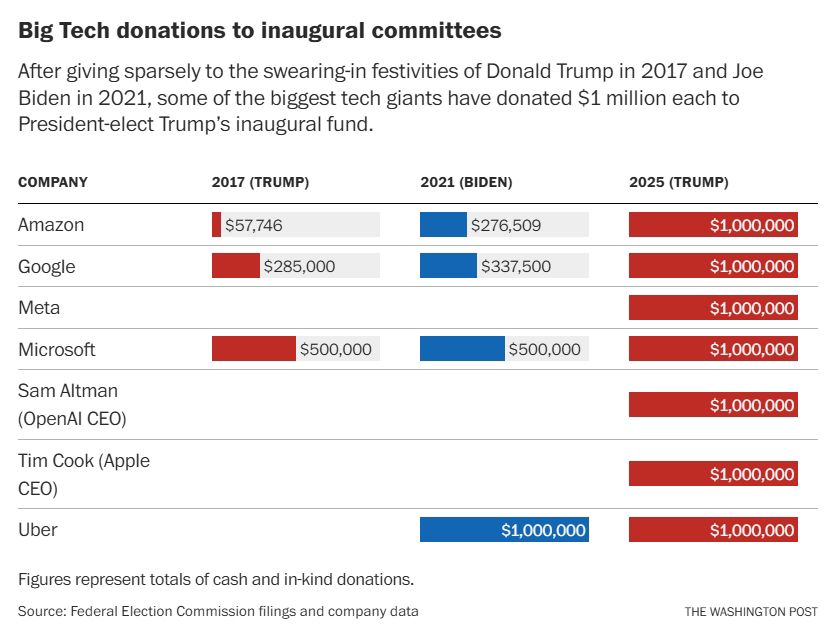
Trump successfully demonstrated that he could be bought. Everyone took note. Now they’re falling all over themselves to pay.
For those who deci...
JC
Jerome Codycommented · 19 hours ago
The Trump administration backed OpenAI in its legal battle with the New York Times, arguing in a brief that barring AI companies from training their models on publishers’ output would be unfair and hurt U.S. technological competitiveness. #The Most Important Thing The legal brief, filed by lawyers for the Department of Justice with the U.S. District Court for the Southern District of New York, argues that the Times is seeking an overly narrow definition of “fair use” that would improperly restrict how large language models are trained. The Times sued OpenAI and its early partner and backer Microsoft in 2023, alleging that the companies had violated the news organization’s copyright protections by training OpenAI on its content. The Trump administration’s brief argued that training AI models on copyrighted material doesn’t inherently violate copyright laws, and that defining fair use too narrowly would hurt competition for the U.S. broadly and among AI companies, because smaller companies might not be able to afford licensing fees. “It is not in the public’s interest for the largest technology companies to have an oligopoly on LLM training due to licensing entry barriers that function primarily as large subsidies for old mainstream media companies,” the brief says. The brief is consistent with both the administration’s longstanding antipathy toward the Times and other mainstream news outlets and President Trump’s prior statements that AI progress is too important for U.S. competitiveness to be hampered by stringent copyright protections. https://www.theguardian.com/technology/2026/sep/02/trump-new-york-times-lawsuit-ai